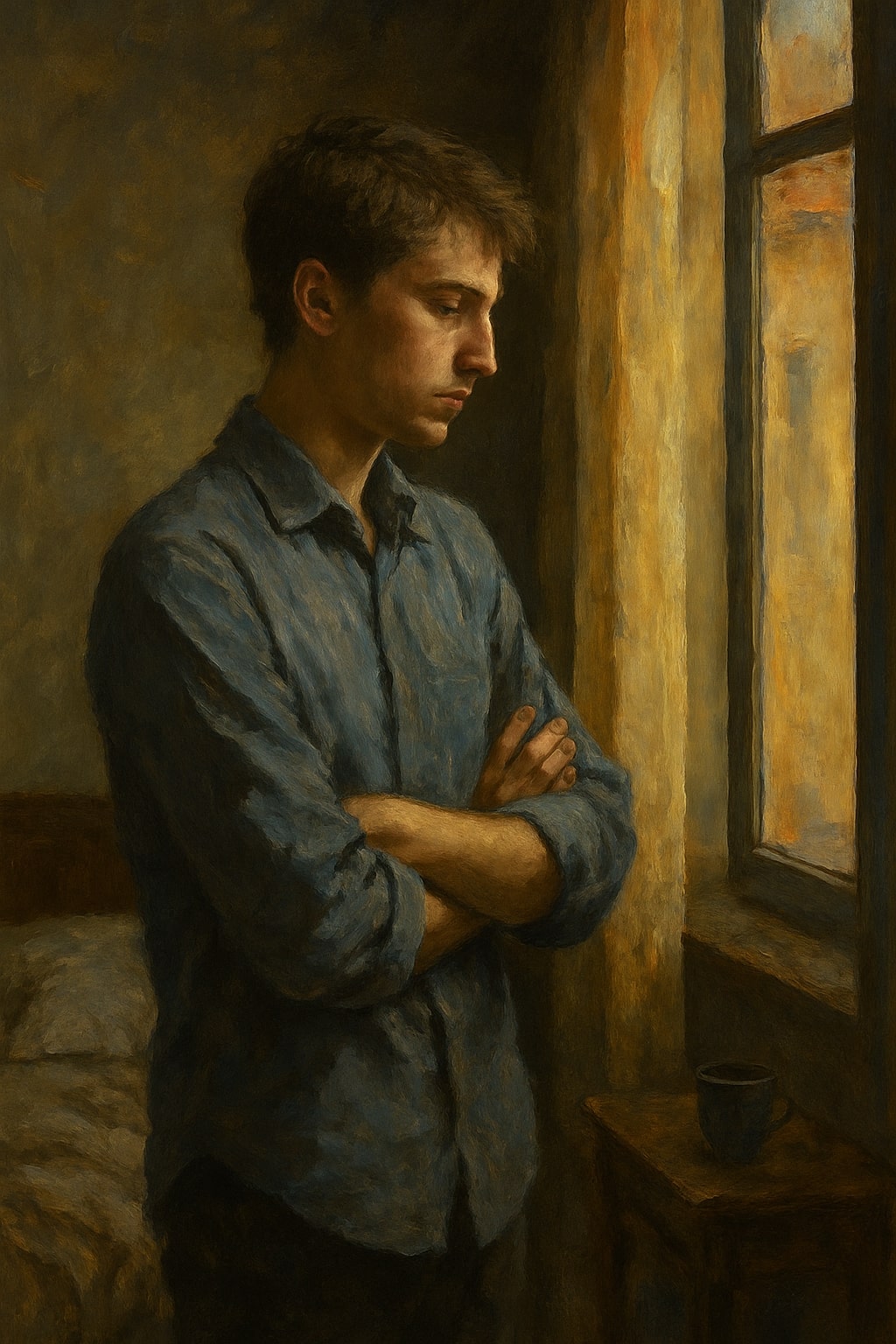
The morning light fell through the kitchen window at the same angle it always had, but something had shifted. Where Lydia usually sat with her coffee and laptop, scrolling through emails while steam rose from her mug, there was only the wooden chair and the square of sunlight it occupied. The light seemed louder somehow, more insistent without her there to soften it with movement and breath.
I stood in the doorway of our small casita, barefoot on the cool tile, watching that empty space. Three days since she’d left for Guerrero. Her sustainability conference had wrapped yesterday, but the silence from her phone stretched longer than it should have. Lydia never went dark. Not the woman who answered client calls at midnight and sent project updates from airport lounges.
The coffee maker gurgled to life, and I realized I’d started it without thinking. Muscle memory reaching for the routine that had shaped our mornings for two years. I poured one cup instead of two, the sound of liquid hitting ceramic strangely hollow in the quiet house.
Outside, the bells of Santa Prisca began their eight o’clock chime, echoing off the whitewashed walls of Taxco’s narrow streets. I’d grown to love that sound, the way it marked time in a place that seemed to exist outside of schedules and deadlines. Lydia had fallen asleep to those bells on her first night here, curled against my shoulder while I worked late on a client’s website redesign.
My phone sat silent on the counter. No morning text. No photo of the rural village where she was supposed to be documenting water filtration systems. Nothing.
I opened the news app and typed “Guerrero News.” The screen filled with headlines, each one pulling something tight in my chest. Earthquake. 6.7 magnitude. Infrastructure damage. Communication towers down across three municipalities. The epicenter was forty kilometers from where Lydia’s last GPS ping had placed her.
My hands moved without permission, opening her contact, pressing call. Straight to voicemail. Her voice, warm and professional, asking me to leave a message. I hung up before the beep.
The rational part of my mind built careful explanations. Cell towers were down. She was in a remote area. Her phone battery had died. She was busy helping with relief efforts, too focused to check in. Lydia was competent. Prepared. She carried backup batteries and satellite communicators for exactly these situations.
But competence felt fragile against the weight of silence.
I walked through the house, looking for something to do with my hands. The bed was made, corners tucked the way she’d taught me, though I’d slept restlessly on top of the covers. Her side remained smooth, untouched. Her travel clothes were gone, but her presence lingered in smaller details. The book splayed open on the nightstand, a receipt marking her place. The faint scent of black cherry and nightfall still clinging to her pillow.
In the kitchen, I noticed the light again. How it fell exactly where she should be sitting. I pulled out my laptop and tried to work, but every notification sound made me reach for my phone. Each time, nothing.
Elena knocked softly at the front door around noon, carrying a covered plate. Our landlady spoke in careful Spanish, slower than usual, her weathered hands gesturing toward the mountains. I caught fragments. “Noticias.” “Terremoto.” “Tu esposa.” Your wife. The words made something flutter in my chest. We weren’t married, but the Spanish language didn’t seem to care about the technical details of our commitment.
She set the plate on the counter and studied my face. Her dark eyes held a particular gentleness I’d only seen her use with wounded birds and stray cats. She touched my shoulder briefly, said something I didn’t understand, and left me alone with the smell of fresh tortillas and the weight of her unspoken concern.
The food sat untouched while I refreshed news sites and checked satellite maps. The affected region spread across my screen like a painful bruise, marked with red dots indicating landslides and road closures. I zoomed in until the pixels broke apart, as if proximity to the digital image might somehow bring me closer to her.
By evening, the silence had texture. It pressed against the walls of the house, making every familiar sound feel strange. The refrigerator humming. The creak of old wood settling. The distant conversations of neighbors walking past our courtyard.
I was washing the single coffee cup when I found it.
Tucked between the recipe box and the salt shaker, folded in half and written in Lydia’s careful handwriting, was a piece of paper I’d never seen before. “Things I Do That No One Notices,” it read at the top. Below, in numbered lines, a catalog of invisible labor.
1. Check the weather each morning and adjust the thermostat so you wake up comfortable.
2. Buy the coffee you like even though I prefer the other brand.
3. Water the plants before traveling so they don’t die while I’m gone.
4. Set out your vitamins next to your breakfast plate.
5. Answer Elena’s questions about groceries because you’re too shy to try Spanish.
6. Remember which news stories upset you and avoid bringing them up in conversation.
The list continued for twenty-three items. Small gestures. Tiny considerations. The infrastructure of care that had run so smoothly beneath our daily life that I’d stopped seeing it entirely.
My finger traced the words, and something fractured inside my chest. Not the sharp crack of breaking, but the slow separation of something that had been held together by force of habit rather than conscious attention.
This wasn’t just about an earthquake or failed communication towers. This was about the earthquake that had been building in the space between us while I remained comfortable in my assumption that love meant having someone who made life easier, not questioning what that ease cost her.
I folded the paper carefully and slipped it into my pocket. Outside, the evening bells began to ring, marking another day’s end in a town that had witnessed countless small heartbreaks and quiet revelations.
Somewhere in the mountains, Lydia was either safe or she wasn’t. Either coming back or she wasn’t. But in this kitchen, under this insistent light, I finally understood what I should have been asking all along.
Not whether she was okay.
But whether I had ever really seen her at all.
The power went out at dawn on the fourth day.
I woke to silence where the hum of the refrigerator should have been, the digital clock on the nightstand dark. Outside, voices carried across the courtyard in rapid Spanish, neighbors calling to each other about generators and candles. The infrastructure that connected this mountain town to the wider world had always been fragile. Now it felt gossamer-thin.
I dressed in yesterday’s clothes and made coffee on the gas stove, the blue flame steady beneath the metal pot. Through the kitchen window, I watched Elena moving through her garden, checking the tomato plants and adjusting the plastic sheeting that protected her herbs from morning frost. She moved with the unhurried precision of someone who had weathered countless small disasters.
When she saw me watching, she approached the window and spoke in careful Spanish. I caught enough to understand she was asking about Lydia. “No noticias,” I replied, the words feeling clumsy in my mouth. No news.
Elena’s expression shifted, softening around the edges. She disappeared into her house and returned with a thermos of café con leche and a plate wrapped in a clean dish towel. As she handed them through the window, she said something that included Lydia’s name and the word “platica.” Talk. Conversation.
“Con usted?” I asked. With you?
“Sí. Cada mañana.” Every morning.
The coffee cup trembled slightly in my hands. Each morning, while I worked at my laptop, Lydia had been sharing coffee and conversation with Elena. In Spanish I didn’t know she spoke well enough for real intimacy. About things I had never thought to ask about.
“Qué platica?” What did you talk about?
Elena studied my face for a long moment, then touched her heart and shook her head. “Después,” she said gently. Later.
I spent the morning moving restlessly through the house, checking my phone for signal bars that never appeared. The silence pressed against me differently now, weighted with the knowledge of conversations I’d never been part of, a version of Lydia I’d barely glimpsed.
Around noon, a car engine growled up the steep cobblestone street, growing louder as it approached our courtyard. I looked out to see a dusty jeep parking outside Elena’s gate, and a familiar figure unfolding from the driver’s seat.
Jonah Flynn. Six-foot-three and perpetually amused by the world’s minor tragedies. He wore wrinkled khakis and a button-down shirt that suggested he’d driven straight from the airport without stopping. His presence filled the small courtyard like a radio turned up too loud.
“Jesus, Caleb,” he called out, spotting me through the window. “You look like hell.”
I opened the front door as he jogged across the courtyard, his canvas messenger bag bouncing against his hip. The same bag he’d carried through college, now held together with duct tape and stubbornness.
“What are you doing here?” I asked.
“Heard about the earthquake on the news. Figured you might need a hand.” He brushed past me into the house, surveying the spare furniture and whitewashed walls. “Nice place. Very… authentic.”
“How did you even find us?”
“Lydia sent me photos last month. Plus, your location sharing is still on from that hiking trip in Vermont.” He dropped his bag on the kitchen counter and opened the refrigerator, frowning at its modest contents. “So where is the lovely Mrs. Alden? Out documenting the local sustainable farming practices?”
The casual way he said it, as if Lydia’s absence was just another adventure to be catalogued in his travel writing, made something sharp twist in my stomach.
“She’s missing,” I said.
Jonah turned, eyebrows raised. “Missing missing, or just off the grid?”
“There was an earthquake. Communication towers are down. I haven’t heard from her in four days.”
“Four days?” He laughed, the sound too bright for the small kitchen. “Caleb, it’s Lydia. She probably found some village that needs a new water system and forgot to check her phone. You know how she gets when there’s a project to manage.”
I wanted to argue, to explain about the list and the empty coffee cup and the way Elena’s eyes had gone soft with sympathy. Instead, I found myself nodding, as if his certainty could make mine return.
“You’re probably right,” I said.
But I wasn’t convinced. And Jonah’s easy dismissal only amplified the wrongness I’d been feeling since she left.
That afternoon, while Jonah napped off his travel fatigue, I tried calling Lydia’s colleagues. Her assistant in Boston hadn’t heard from her since the conference ended. The regional director in Mexico City said communication with the rural sites had been spotty since the earthquake, but he expected updates soon.
“She was planning to visit the Ayala village project after the conference,” he told me. “But that was before the seismic activity. She may have altered her itinerary.”
“Altered it how?”
“I’m not certain. She mentioned wanting to assess damage in the affected areas. Lydia has a tendency to… expand her scope when she sees need.”
After the call, I sat staring at my phone screen. She’d changed her plans and hadn’t told me. That wasn’t like her. Lydia scheduled everything, communicated every detail. Her calendar lived in her phone like a second heartbeat.
Unless she’d stopped wanting to share those details with me.
I found myself in the bedroom, opening dresser drawers with no clear purpose. Her clothes were still there, folded with the precision she brought to everything. But beneath her sweaters, I discovered something I’d never seen before.
A notebook. Small, leather-bound, filled with her careful handwriting.
I opened it to a random page, telling myself I was looking for contact information. Emergency numbers. Something that might help me find her.
Instead, I found this:
March 15th – He made coffee this morning while I was on a client call. Set it next to my laptop without a word. These small kindnesses mean everything, but I wonder sometimes if he sees them as transactions. I give him stability, he gives me coffee. I give him space to work, he gives me space to travel. We’ve built something comfortable, but I’m not sure we’ve built something true.
My hands went numb around the notebook’s edges.
March 28th – Fought with Mom about Easter plans. Called Caleb after, crying in the bathroom at work like a teenager. He listened, said the right things, but I could hear him typing in the background. Sometimes I’m afraid the people who rely on me don’t love me—they just love how stable I make their lives.
The words arranged themselves on the page like small, precise cuts. I flipped backward, reading entries that spanned months. Her promotion at work, her concerns about her father’s health, her growing frustration with my emotional distance. A entire inner life I’d somehow missed entirely.
April 2nd – Caleb asked if I was happy, and I realized I couldn’t answer him honestly. Not because I’m unhappy, but because I’ve gotten so good at managing everyone else’s needs that I’ve forgotten how to name my own.
I closed the notebook, but the damage was done. Every page revealed a woman I lived with but had never really met. Someone who carried weight I’d never offered to share, who asked questions I’d never thought to ask in return.
The front door opened with a creak of old hinges. Jonah’s voice echoed through the house.
“Caleb? You need to see this.”
I found him in the living room, laptop open, a news article filling the screen. The headline read “Remote Villages Cut Off Following Guerrero Earthquake.” Below it, a photograph of a collapsed bridge and a list of affected communities.
“Ayala,” Jonah said, pointing to a name in the third paragraph. “That’s where her colleague said she was headed, right?”
I leaned closer to read. The article described landslides blocking access roads, damaged infrastructure, and multiple casualties in the region’s smaller settlements. Rescue workers had reached some areas, but others remained completely isolated.
“Local authorities report several injuries among volunteers and aid workers,” I read aloud. “Names have not been released pending notification of families.”
The words blurred at the edges. Several injuries. Names not released.
Jonah closed the laptop gently. “It doesn’t mean anything,” he said. “She could be anywhere. She could be helping with relief efforts. She could be—”
“Stop.” The word came out harder than I intended. “Just stop pretending this is normal.”
He looked at me with something like surprise, as if I’d suddenly become interesting in a way I hadn’t been before.
Outside, the evening bells began to ring, marking another day’s end without a word from her. Another night of not knowing whether she was safe, or hurt, or deciding that whatever we’d built together wasn’t worth coming back to.
I thought about the list in my pocket, the journal entries burned into my memory, and the conversations with Elena I’d never witnessed. All the ways I’d failed to see the woman who’d been sitting across from me each morning, making our life work while I remained grateful but unaware.
The power flickered back on with a soft hum, bringing the house back to life. But the light in the kitchen fell empty as ever, and for the first time since she’d left, I allowed myself to consider the possibility that even if Lydia was safe, even if she came home unharmed, the damage between us might already be irreversible.
Some earthquakes happen all at once. Others take years to register on any instrument sensitive enough to measure them.
Jonah found me on the fifth morning, standing in the kitchen with Lydia’s journal open in my hands. I’d been reading the same entry over and over, searching for clues I might have missed, patterns that could tell me where she’d gone or why she’d stopped sharing her plans with me.
“Still nothing?” he asked, pouring himself coffee from the pot I’d made an hour earlier.
I closed the journal and slipped it back into the drawer. “Nothing.”
“You know what your problem is?” He leaned against the counter, studying me with the particular intensity he reserved for articles he was trying to write. “You’re treating this like she’s helpless. Like she needs saving.”
Something hot flared in my chest. “She’s been missing for five days.”
“She’s been unreachable for five days. There’s a difference.” He took a sip of coffee and made a face. “This tastes like anxiety, by the way. You’re over-extracting the beans.”
“How can you be so calm about this?”
“Because I know Lydia. Really know her.” The emphasis on ‘really’ carried weight I didn’t like. “She’s not some fragile flower who gets lost in the woods. She’s the woman who negotiated water rights agreements with three different governments. She’s probably organizing relief efforts and forgot to charge her satellite phone.”
“That’s not—” I started, then stopped. How could I explain about the journal, the list, the morning conversations with Elena? How could I tell him that the Lydia I thought I knew was apparently a stranger to the woman who’d been living in this house?
“That’s not what?”
“You think you know her better than I do.”
Jonah set down his coffee cup and looked at me with something approaching pity. “I think I knew her differently than you do. Past tense. But yeah, maybe I did see things you missed.”
“Like what?”
“Like the fact that she gets exhausted carrying other people’s emotional weight. Like how she goes quiet when she feels unheard. Like how she needs someone to actually ask what she’s thinking instead of just appreciating how well she manages everything.” He paused, watching my face. “You think being safe to lean on is love, Caleb. But did you ever ask what she leaned away from to keep you comfortable?”
The words settled into place with unwelcome accuracy. I opened my mouth to argue, to defend myself, but found nothing there. Because he was right. I’d loved being the steady one, the reliable partner who didn’t create drama or demand emotional labor. I’d worn my low-maintenance nature like a badge of honor.
“That’s not fair,” I managed.
“Isn’t it?” Jonah’s voice went gentler, which somehow made it worse. “Look, I’m not trying to be cruel. But I watched you two together last time I visited. She was telling a story about some crisis at work, something about a project falling apart in Guatemala. You were nodding and making sympathetic noises, but you were also checking your phone. She noticed. I saw her face when she realized you weren’t really listening.”
I remembered that evening. Lydia had been animated, gesturing with her wine glass as she described the challenges of coordinating with local authorities. I’d been half-listening, distracted by client emails that couldn’t wait until morning. Or so I’d told myself.
“I was working,” I said weakly.
“You were avoiding. There’s a difference.”
The accusation sat in the space between us, like something alive and hungry. I wanted to deny it, to list all the ways I’d supported her career, all the dinners I’d cooked while she worked late, all the times I’d encouraged her to take the promotion or the difficult assignment.
But support wasn’t the same as seeing. And encouraging wasn’t the same as asking.
“I need some air,” I said.
I left Jonah in the kitchen and walked out into the courtyard, past Elena’s garden where the tomato plants drooped under the afternoon sun. The cobblestone streets were slick with recent rain, reflecting fragments of blue sky and white clouds. I walked without direction, letting my feet find their way through Taxco’s maze of narrow alleys and steep staircases.
The town pulsed with life around me. Vendors calling out prices in rapid Spanish. Children chasing a ball between parked cars. The distant sound of hammer on metal from one of the silver workshops that had made this place famous. Normal life continuing while mine hung suspended in uncertainty.
I found myself in the Plaza Borda as the evening light began to settle over the mountains. The square buzzed with families and tourists, street musicians and vendors selling corn and fresh fruit. I sat on a bench beside the fountain and watched the flow of people, remembering the night Lydia had danced here.
It was our second week in Taxco. We’d come to the plaza for dinner and stayed for the music. A man with a guitar had been playing old Mexican songs, his voice carrying over the splash of the fountain. Lydia had been drawn to the music like metal to a magnet, her body swaying with the rhythm.
When the musician nodded toward her, inviting her to dance, she’d laughed and shaken her head. But he’d persisted, switching to a song I recognized—”La Llorona”—and extending his hand with old-fashioned courtesy. She’d looked at me as if asking permission.
I’d nodded, smiling, proud of her willingness to embrace the moment. Proud to be with someone so alive, so open to experience.
But I hadn’t joined her. I’d sat on this same bench, watching her move with unselfconscious grace while elderly couples and young mothers clapped in time with the music. She’d beckoned to me once, eyes bright with laughter, but I’d shaken my head and gestured to indicate I was happy watching.
The truth was, I’d been afraid. Afraid of looking foolish, of not knowing the steps, of being the awkward American who couldn’t match her natural rhythm. So I’d stayed safe on the sidelines while she danced alone in a crowd of strangers who appreciated her more in that moment than I had.
Watching. Always watching. Never participating fully in the life she was trying to build with me.
The thought settled over me like twilight, gradual and then complete. I hadn’t loved Lydia with my whole heart. I’d loved the way she loved me. Loved how she made space for my quieter nature, how she filled the silences I couldn’t bridge, how she carried the emotional work of our relationship so I could remain comfortable in my own skin.
I’d been a passenger in my own love story.
The fountain continued its gentle splash beside me as the plaza slowly emptied. Families gathered their children and headed home for dinner. The musician packed up his guitar and disappeared into the gathering dusk. I sat alone with the weight of understanding, feeling something fundamental shift in my chest.
This wasn’t about an earthquake or communication towers or even the dangerous work she’d been doing in remote villages. This was about the earthquake that had been building in the foundation of us while I remained oblivious to the stress fractures.
The antagonist in this story wasn’t fate or natural disaster or even the possibility of loss. It was me. My comfortable blindness. My willingness to let her carry the weight of really knowing each other while I coasted on the surface of our shared life.
I pulled out my phone and opened my email, fingers moving across the screen before I could think better of it. The words poured out in a rush, everything I’d failed to say, failed to see, failed to ask. I wrote about the journal entries that had cut me open, about the conversations with Elena I’d never witnessed, about the way I’d confused being low-maintenance with being emotionally absent.
I didn’t know you were tired, I typed. I didn’t know you felt unseen. I thought I was being a good partner by not asking for too much, but I realize now I wasn’t asking for enough. I wasn’t asking for you.
I love you. Not the way you make my life easier, not the way you handle things so I don’t have to, but you. The woman who sits with Elena each morning talking about things I never thought to wonder about. The woman who changes her travel plans to help people but doesn’t tell me because she’s learned I prefer my world predictable.
Come home. Please. Let me try to love you the way you deserve to be loved.
I read it twice, made small edits, then pressed send before I could lose my nerve.
The email bounced immediately. “Delivery failure. Recipient’s inbox is inactive.”
I stared at the error message until the words blurred together. Her email was down. Her phone was dead. Every digital thread that connected us had been severed, leaving me alone with the terrible clarity of everything I’d failed to understand while she was still here to teach me.
The walk back to the house passed in a haze. Jonah had gone to bed, leaving the kitchen clean and dark. I moved through the rooms like a ghost, seeing them with new eyes. The carefully arranged books on the shelf, half mine, half hers, but somehow never quite integrated. The photographs on the wall that documented our travels but revealed nothing of our inner lives. The space we’d shared without ever really inhabiting it together.
In the bedroom, I sat on the edge of the bed and whispered her name into the empty air.
“Lydia.”
The sound fell into the darkness and disappeared, absorbed by white walls and silence. It felt like grief. Not the anxiety of waiting or the fear of uncertainty, but the hollow ache of actual loss. As if she were already gone and I was just now catching up to the truth of her absence.
I lay back on the covers and closed my eyes, listening to the night sounds of Taxco settling into sleep. Somewhere in the mountains, Lydia was either safe or she wasn’t, coming home or she wasn’t. But here in this room we’d shared, I finally understood what I’d been too blind to see while she was still here to show me.
The woman I loved had been disappearing long before she ever left for Guerrero. She’d been fading from our life one unasked question at a time, one unnoticed gesture at a time, one unshared silence at a time.
And I’d been so comfortable in my ignorance that I’d never even noticed she was going.
The call came at sunrise on the seventh day.
I’d been awake for hours, sitting in the kitchen with cold coffee and Elena’s untouched breakfast, watching the light creep across the courtyard tiles. Jonah had left the evening before, frustrated by my refusal to return to Boston and “deal with this like a rational person.” The house felt hollow without even his abrasive certainty to push against.
When my phone buzzed with an incoming video call from an unknown number, my hands trembled so badly I nearly dropped it.
The screen flickered to life, pixelated and unstable. A woman’s face appeared through the digital static, dusty, exhausted, a small bandage across her left temple. But unmistakably, impossibly alive.
“Caleb?”
Lydia’s voice came through tinny and delayed, the satellite connection struggling across whatever distance separated us. She looked smaller than I remembered, sitting in what appeared to be a concrete room with exposed electrical wiring and water stains on the walls.
“Are you okay?” The words came out strangled, barely audible.
“I’m okay. Bruised, tired, but okay.” She shifted, and I caught a glimpse of her right arm in a makeshift sling. “The clinic finally got their satellite phone working. I’ve been trying to reach you for two days.”
Two days. While I’d been spiraling through guilt and self-recrimination, she’d been trying to call me.
“Where are you?”
“About sixty kilometers east of where I was supposed to be. There was a village that got cut off by landslides. No road access, no communication. They needed medical supplies, someone who could coordinate with relief agencies.” She paused, studying my face through the poor connection. “You look terrible.”
“I thought—” I stopped, unsure how to finish. I thought you were dead. I thought you’d left me. I thought I’d lost you before I ever really found you.
“I know.” Her voice went softer. “I’m sorry I couldn’t call sooner. Everything’s been chaos here.”
We looked at each other through the grainy screen, seven days and countless realizations stretching between us. She appeared so far away, not just geographically but somehow fundamentally altered by whatever she’d experienced in those remote mountains.
“I found your list,” I said finally.
“My list?”
“Things you do that no one notices. It was in the kitchen.”
Something shifted in her expression, a wariness creeping around her eyes. “I forgot about that.”
“I also found your journal.”
The confession hung in the digital space between us. Lydia closed her eyes briefly, and when she opened them, they held a sadness I’d never seen before.
“You read it.”
“I was looking for emergency contacts. For anything that might help me find you.” The explanation sounded thin even to me. “But I kept reading.”
“And?”
“And I realized I’ve been living with a stranger.” The words came out rougher than I intended. “Not because you were hiding things, but because I never asked to know them. I never asked what you were thinking, what you needed, what it cost you to make our life work so smoothly.”
Lydia was quiet for a long moment. In the background, I could hear voices speaking rapid Spanish, the distant sound of machinery.
“I miss you,” I continued, the words coming from some deeper place I’d only recently discovered. “I missed you like I finally understood what breath was, and then forgot how to take it.”
“Caleb—”
“Let me finish. Please.” I leaned closer to the phone, as if proximity to the screen could somehow bridge the distance between us. “I loved the way you loved me. The way you anticipated my needs, managed the complications, carried the emotional weight so I could stay comfortable. I thought that was what made me a good partner, being easy to love. But I never asked what that ease cost you.”
The connection wavered, her image freezing for a moment before resuming. When she spoke again, her voice was careful, measured.
“I didn’t need you to panic. I needed you to notice. To ask questions. To wonder about the parts of my life that happened when you weren’t paying attention.” She paused, touching the bandage on her temple absently. “But thank you. For finally seeing me.”
“I want to do better.”
“Do you? Or do you want to feel better about not doing better before?”
The distinction was uncomfortable. She was asking whether my newfound awareness was genuine transformation or just guilt seeking absolution.
“I don’t know,” I admitted. “But I want to find out. If you’ll let me.”
“This isn’t going to be easy,” she said. “I can’t go back to managing your emotional education while also managing everything else. If we’re going to try this, really try, you have to show up differently.”
“I understand.”
“Do you?” Her eyes searched my face through the pixelated screen. “Because I need a partner, not a project. I need someone who asks about my day and actually listens to the answer. Someone who notices when I’m tired, when I’m worried, when I need support instead of space.”
“I want to be that person.”
“Then we start there. Not with promises about who you’ll become, but with presence. With paying attention. With doing the work of actually knowing each other.”
The call began to break up, her voice cutting in and out as the satellite connection struggled. “—have to go—back in two days—talk more then—”
“Lydia, wait—”
But the screen went dark, leaving me alone with the echo of her words and the weight of everything unsaid.
I sat in the kitchen for a long time after the call ended, watching the morning light settle into its familiar pattern. But something fundamental had shifted. The empty chair across from me no longer felt like an absence. It felt like space waiting to be filled differently.
I stood and moved through the house with new purpose. I gathered the dishes that had been sitting unwashed for days and cleaned them properly. I swept the floors, made the bed with hospital corners the way she’d taught me, and opened the windows to let fresh air move through the rooms.
In the afternoon, I walked to the market in the town center. The vendors called out greetings in Spanish I was finally motivated to understand. I bought fresh tomatoes, the good coffee Lydia preferred, and a small succulent in a terra cotta pot, something living that would need daily attention.
Elena found me arranging these items in the kitchen when she came by with dinner.
“Viene a casa?” she asked. Is she coming home?
“Sí,” I said, then attempted something more complex. “En dos días. Está… está bien.”
Elena smiled, the first real smile I’d seen from her since Lydia left. She helped me place the plant in the window where it would catch the morning light, then showed me how to water it properly, just enough, not too much, watching for signs of what it needed.
That evening, I set the table for two. Not in anticipation of Lydia’s immediate return, but as practice. Learning to see the space between us as something to be actively tended rather than passively inhabited.
I placed her chipped ceramic mug beside her usual chair, the one with the small crack along the handle that she’d refused to replace because it fit her grip perfectly. Such a small thing, but suddenly I understood it as part of a larger pattern, her attachment to objects that carried history, her preference for things that had been shaped by use rather than designed for perfection.
How many other preferences had I never noticed? How many small revelations waited in the details of her daily life?
The sun set behind the mountains, painting the kitchen walls in shades of gold and amber. I sat at the table with a notebook and began making a different kind of list. Not things I needed to fix or problems to solve, but questions I wanted to ask her. About her work, her dreams, her fears. About the conversations she had with Elena, the projects that excited her, the moments when she felt most herself.
The door was still closed. Lydia was still two days away, still recovering in a clinic I couldn’t picture, still deciding whether what we’d built was worth repairing.
But the room wasn’t empty anymore.
Because I’d stopped mistaking proximity for presence.