Stellar AMMs Explained
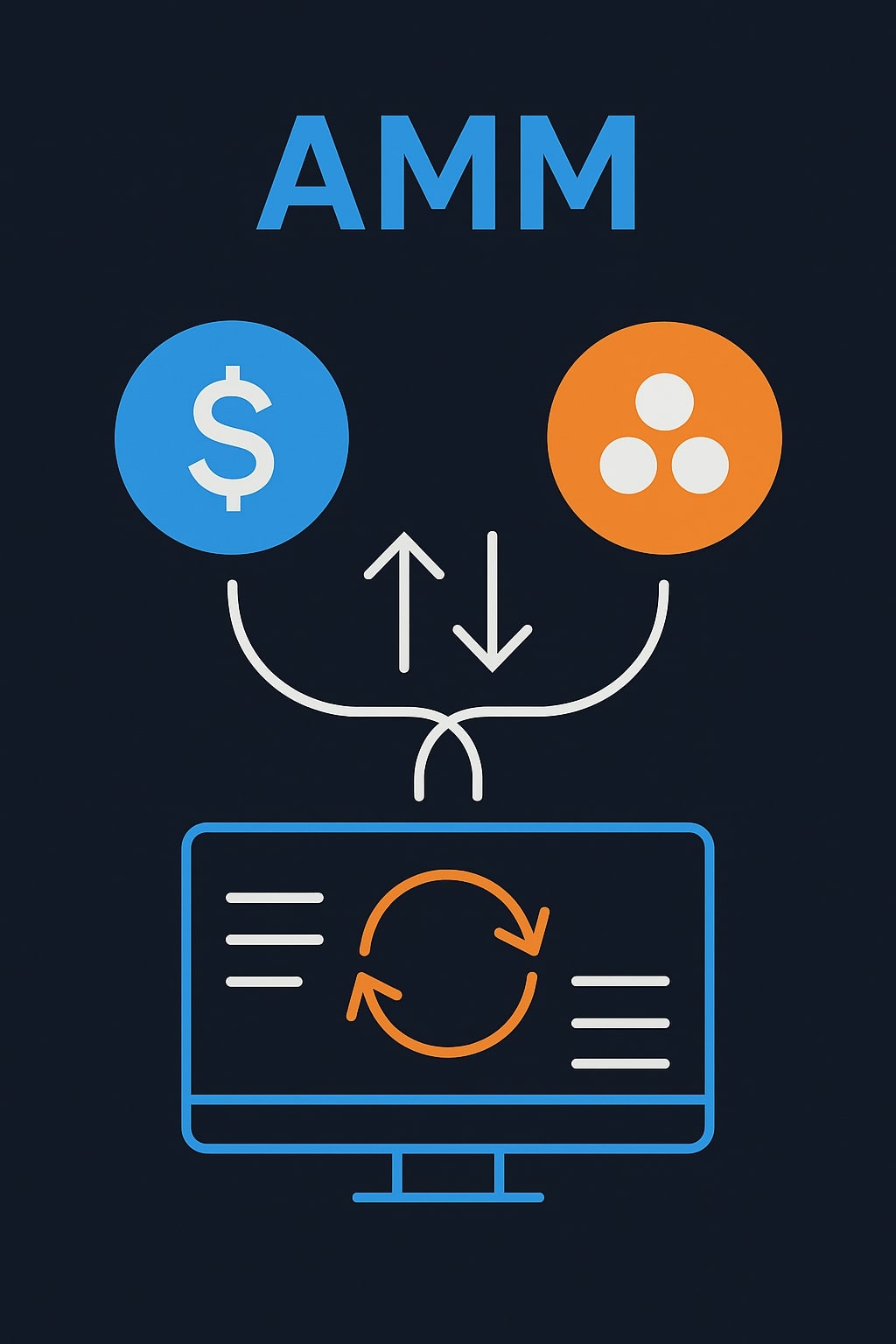
Automated Market Makers (AMMs) have revolutionized decentralized trading, and Stellar’s protocol-native implementation represents a major leap forward in efficiency and accessibility. Unlike other blockchains that rely on smart contracts, Stellar integrated AMM functionality directly into its consensus layer with Protocol 18, creating a seamless trading experience with minimal fees and instant settlement. This breakthrough eliminates the complexity and high costs associated with traditional smart contract AMMs while maintaining all the benefits of decentralized liquidity provision.
The significance extends beyond technical innovation. Stellar’s AMMs integrate seamlessly with the existing Stellar Decentralized Exchange (DEX), creating a hybrid model that automatically routes trades through the best execution venue. With fixed 0.00001 XLM transaction fees and the proven constant product formula, Stellar offers one of the most cost-effective and reliable AMM experiences in DeFi. Since launching in November 2021, these AMMs have facilitated millions in trading volume across major pairs like XLM/USDC and BTC/USDC, with some liquidity providers earning over 50% APY.
What are automated market makers?
Traditional cryptocurrency exchanges operate like stock markets, using order books where buyers and sellers place orders at specific prices. A trade only executes when someone wants to buy exactly what someone else wants to sell at the same price. This system works well for popular assets but struggles with newer or less common tokens that lack sufficient buyers and sellers.
Automated Market Makers solve this liquidity problem by replacing human market makers with mathematical algorithms. Instead of matching individual buy and sell orders, AMMs create liquidity pools containing reserves of two tokens. Users trade directly against these pools using predetermined mathematical formulas that automatically calculate prices based on the ratio of tokens in the pool.
The core innovation lies in democratizing market making. Anyone can become a liquidity provider by depositing equal values of two tokens into a pool, earning a share of trading fees proportional to their contribution. This creates continuous liquidity for any token pair, enabling 24/7 trading without waiting for matching orders.
AMMs versus traditional order book exchanges
The fundamental difference between AMMs and order books lies in their approach to price discovery and liquidity provision. Order book exchanges rely on active traders placing orders at specific prices, creating a dynamic market where prices change based on supply and demand imbalances. This system excels for high-volume, established trading pairs but struggles with illiquid markets where few traders participate.
AMMs use mathematical formulas to determine prices automatically, creating predictable but non-linear pricing curves. Every trade slightly adjusts the token ratio in the pool, which immediately updates the price for the next trader. This system guarantees liquidity for any trade size, though larger trades experience higher slippage due to their greater impact on the pool’s balance.
The trade-offs are significant. Order books offer superior price efficiency for large trades and support advanced order types like limit orders and stop-losses. They also enable professional market makers to provide tight spreads for popular pairs. However, they require constant market maker activity and can suffer from liquidity gaps during volatile periods.
AMMs sacrifice some price efficiency for guaranteed availability and simplicity. They excel at providing liquidity for long-tail assets, offering a straightforward swap interface, and enabling anyone to earn fees through liquidity provision. The constant availability makes them ideal for automated systems and cross-border payments where immediate execution matters more than optimal pricing.
Stellar’s revolutionary protocol-native implementation
Stellar’s approach to AMMs represents a fundamental departure from other blockchain implementations. While Ethereum-based AMMs like Uniswap require complex smart contracts and high gas fees, Stellar built AMM functionality directly into Protocol 18, which launched November 3, 2021. This protocol-native design provides several crucial advantages.
The LiquidityPoolEntry ledger type stores the pool state directly in Stellar’s consensus layer, eliminating smart contract complexity and associated risks. Each liquidity pool uses the proven constant product formula (x*y=k) with a fixed 0.3% trading fee, identical to Uniswap v2’s model. However, unlike other implementations, Stellar’s AMMs operate as first-class citizens alongside the existing DEX.
This integration creates a unique hybrid trading environment. When users execute path payments or swaps, Stellar’s protocol automatically determines whether to route through AMM pools or DEX order books based on which provides better execution. This intelligent routing happens transparently, so applications built for the Stellar DEX automatically benefit from AMM liquidity without code changes.
The cost advantages are dramatic. While Ethereum AMM trades often cost $20-100 in gas fees, Stellar AMM operations cost exactly 0.00001 XLM (fractions of a penny) regardless of trade size. This fixed cost structure makes small trades economically viable and enables high-frequency strategies impossible on other networks.
The Math of the Constant Product Formula
The mathematical heart of AMMs lies in the constant product formula: x * y = k. This elegant equation maintains market equilibrium by ensuring the product of two token reserves remains constant during trades, creating an automated pricing mechanism that requires no human intervention.
Consider a simple example: a pool contains 1,000 ETH and 2,000,000 USDC, giving k = 2,000,000,000. The current price equals 2,000,000 ÷ 1,000 = 2,000 USDC per ETH. When someone wants to buy 50 ETH, they must add USDC to maintain the constant product.
The mathematical process works as follows:
- New ETH amount: 1,000 – 50 = 950 ETH
- Required USDC amount: 2,000,000,000 ÷ 950 = 2,105,263 USDC
- USDC cost: 2,105,263 – 2,000,000 = 105,263 USDC
- Average price: 105,263 ÷ 50 = 2,105 USDC per ETH
This represents 5.25% slippage due to the trade’s impact on the pool balance. The constant product formula naturally creates higher prices for larger purchases and lower prices for larger sales, providing automatic market making without human intervention.
Stellar implements this formula with fee integration: (x + δx)(y – δy) ≥ xy(1 + F)² where F equals 0.003 (0.3% fee). This ensures the product actually grows over time as trading fees accumulate in the pool, continuously increasing value for liquidity providers.
Providing liquidity on Stellar AMMs
Liquidity provision on Stellar requires depositing equal dollar values of two tokens into a pool. Users receive pool shares representing their proportional ownership, which automatically accrue trading fees and can be redeemed for the underlying tokens plus accumulated rewards.
The process begins with establishing trustlines for both reserve assets and the pool shares, since Stellar requires explicit trust relationships for all non-native assets. Unlike transferable ERC-20 LP tokens on Ethereum, Stellar pool shares exist as non-transferable trustline balances, providing security benefits but limiting composability with other DeFi protocols.
While liquidity provision has been simplified through many apps, behind the scenes, adding liquidity involves the LiquidityPoolDeposit operation with parameters including maximum amounts for each asset and price bounds to protect against slippage. The protocol calculates pool shares using the formula: new_shares = deposit_value ÷ (total_pool_value ÷ existing_shares). For example, depositing $10,000 into a $1 million pool with 100,000 existing shares yields 1,000 new pool shares.
Fee accumulation happens automatically as the 0.3% trading fee gets added to pool reserves with each trade. If a pool earns $1,000 daily in fees and you own 1% of the pool shares, you earn $10 daily without any action required. These fees compound continuously, increasing the value of each pool share over time.
Withdrawal uses the LiquidityPoolWithdraw operation, which burns pool shares and returns proportional amounts of both reserve assets. The withdrawn amounts reflect current pool ratios, which may differ significantly from initial deposits due to trading activity and price changes.
Trading mechanics on Stellar AMMs
Trading on Stellar AMMs happens through existing path payment operations, requiring no new transaction types or complex interfaces. Users can execute trades using PathPaymentStrictSend or PathPaymentStrictReceive operations, with the protocol automatically determining optimal routing through AMMs, the DEX, or both.
Slippage calculation follows the constant product formula, where larger trades create proportionally higher price impact. A $10,000 purchase in a $100,000 pool creates much higher slippage than the same trade in a $10 million pool. Stellar’s implementation includes slippage protection through price bounds that cause transactions to fail rather than execute at unexpectedly poor prices.
Multi-hop routing represents a key advantage of Stellar’s implementation. Rather than requiring direct token pairs for every possible trade, Stellar can route through multiple pools atomically. A trade from Token A to Token C might route: Token A → XLM → USDC → Token C, with the entire sequence succeeding or failing as one transaction.
Price impact varies significantly with pool size and trade amount. The formula for price impact is: (final_price – initial_price) ÷ initial_price × 100%. In the earlier ETH example, buying 50 ETH created 5.25% price impact. The same percentage trade in a pool 10x larger would create roughly 0.5% impact, demonstrating how deeper liquidity improves price efficiency.
Current ecosystem and major pools
Stellar’s AMM ecosystem has grown steadily since Protocol 18’s launch, with major trading pairs attracting millions in liquidity and generating substantial trading volume. StellarTerm reports over $2.2 million in daily volume, with USDC/XLM representing the most active pair at $1.42 million daily volume.
Popular trading pairs include:
- XLM/USDC: The backbone pair with highest liquidity and volume
- Velo/XLM: A very active liquidity pool
- SHX/XLM: A very active liquidity pool
- BTC/USDC: Active pool serving as a major price reference
- ETH/USDC: Active pool serving as a major price reference
- yXLM/yUSDC: Yield-bearing asset pools providing 5-9% APY plus trading fees
Major platforms supporting Stellar AMMs include StellarX, Lumenswap, Scopuly, and StellarTerm, each offering comprehensive interfaces for trading and liquidity provision. These platforms integrate seamlessly with popular wallets like Freighter, Albedo, and Rabet, providing smooth user experiences across desktop and mobile.
Liquidity providers report attractive returns, with some BTC/USDC pools generating over 50% APY during high volatility periods. Yield asset integration creates dual income streams where providers earn AMM trading fees plus underlying asset yield, making Stellar competitive with traditional DeFi protocols despite lower gas fees.
Benefits and risks of Stellar AMMs
The primary benefits of Stellar AMMs center on accessibility and cost efficiency. With transaction fees under $0.0001 regardless of trade size, users can execute small trades and rebalance positions frequently with minimal economic penalty. The protocol-native implementation eliminates smart contract risks while providing deterministic execution and transparent pricing.
Integration advantages multiply these benefits. Existing applications automatically gain AMM liquidity without code changes, and the hybrid DEX-AMM model provides optimal execution across venues. Path payments can traverse multiple pools and order books atomically, enabling complex multi-asset conversions in single transactions.
However, standard AMM risks apply, with impermanent loss representing the primary concern for liquidity providers. When token prices diverge from initial ratios, providers may end up with less valuable portfolios than simply holding the original tokens. For example, if ETH doubles while USDC remains stable, ETH/USDC liquidity providers will have more USDC and less ETH than if they had just held ETH.
Additional considerations include limited fee customization (fixed 0.3% across all pools) and the non-transferable nature of pool shares, which prevents using them as collateral in other DeFi protocols. The fixed fee structure may not optimize for different asset types, as stablecoin pairs might benefit from lower fees while exotic pairs might justify higher rates.
Mathematical examples and practical calculations
Understanding AMM mathematics through concrete examples illuminates the mechanisms behind automated market making. Consider a EUR/USD pool with 1,000 EUR and 1,170 USD reserves, giving an exchange rate of 1.17 USD per EUR and a constant product k = 1,170,000.
For a trade buying 100 EUR:
- New EUR reserves: 1,000 – 100 = 900 EUR
- Required USD reserves: 1,170,000 ÷ 900 = 1,300 USD
- USD cost: 1,300 – 1,170 = 130 USD
- Effective rate: 130 ÷ 100 = 1.30 USD per EUR
- Price impact: (1.30 – 1.17) ÷ 1.17 × 100% = 11.1%
Adding the 0.3% fee:
- Fee amount: 130 × 0.003 = 0.39 USD
- Total cost: 130.39 USD for 100 EUR
- Final rate: 1.304 USD per EUR
For liquidity provision calculations, imagine depositing $20,000 worth of assets into a $2 million pool with 100,000 existing shares:
- New shares issued: ($20,000 ÷ $2,000,000) × 100,000 = 1,000 shares
- Pool ownership: 1,000 ÷ 101,000 = 0.99%
- If daily fees total $500, your share: $500 × 0.99% = $4.95 daily
The future of decentralized trading on Stellar
Stellar’s AMM implementation represents more than technical innovation, it demonstrates how blockchain protocols can evolve to meet user needs while maintaining their core advantages. The protocol-native approach eliminates many barriers that prevent mainstream adoption of DeFi, from high fees to complex user experiences.
The integration model creates network effects where improved liquidity benefits all participants, whether they use AMMs directly or traditional SDEX functionality. As more assets gain AMM pools, the efficiency of cross-asset payments and conversions improves throughout the network.
For newcomers to DeFi, Stellar AMMs offer an ideal entry point with low financial barriers, transparent pricing, and reduced complexity compared to other platforms. The mathematical certainty of the constant product formula provides predictable outcomes, while the protocol-level integration ensures reliable execution.
As the ecosystem matures, we can expect continued growth in liquidity, new asset pairs, and innovative applications that leverage Stellar’s unique combination of low costs, institutional-grade infrastructure, and DeFi functionality. The foundation is set for Stellar to become a major hub for decentralized trading and cross-border financial services.
Conclusion
Stellar’s automated market makers represent a thoughtful evolution of DeFi infrastructure, combining proven mathematical models with protocol-native efficiency to create accessible, cost-effective trading mechanisms. The constant product formula provides reliable price discovery, while integration with the Stellar DEX ensures optimal execution across all available liquidity sources.
The economics favor both traders and liquidity providers: minimal transaction costs enable strategies impossible on other networks, while attractive fee yields make liquidity provision compelling even for smaller participants. Real-world adoption demonstrates the system’s viability, with millions in daily volume and growing ecosystem participation.
Understanding these mechanics empowers users to participate confidently in Stellar’s DeFi ecosystem, whether as traders seeking efficient swaps or liquidity providers earning passive income. The mathematical foundations ensure predictable outcomes, while the protocol-level implementation provides security and reliability that smart contract systems struggle to match. As decentralized finance continues expanding globally, Stellar’s AMMs provide the infrastructure for efficient, accessible, and cost-effective automated trading that can serve both individual users and institutional applications at unprecedented scale.

