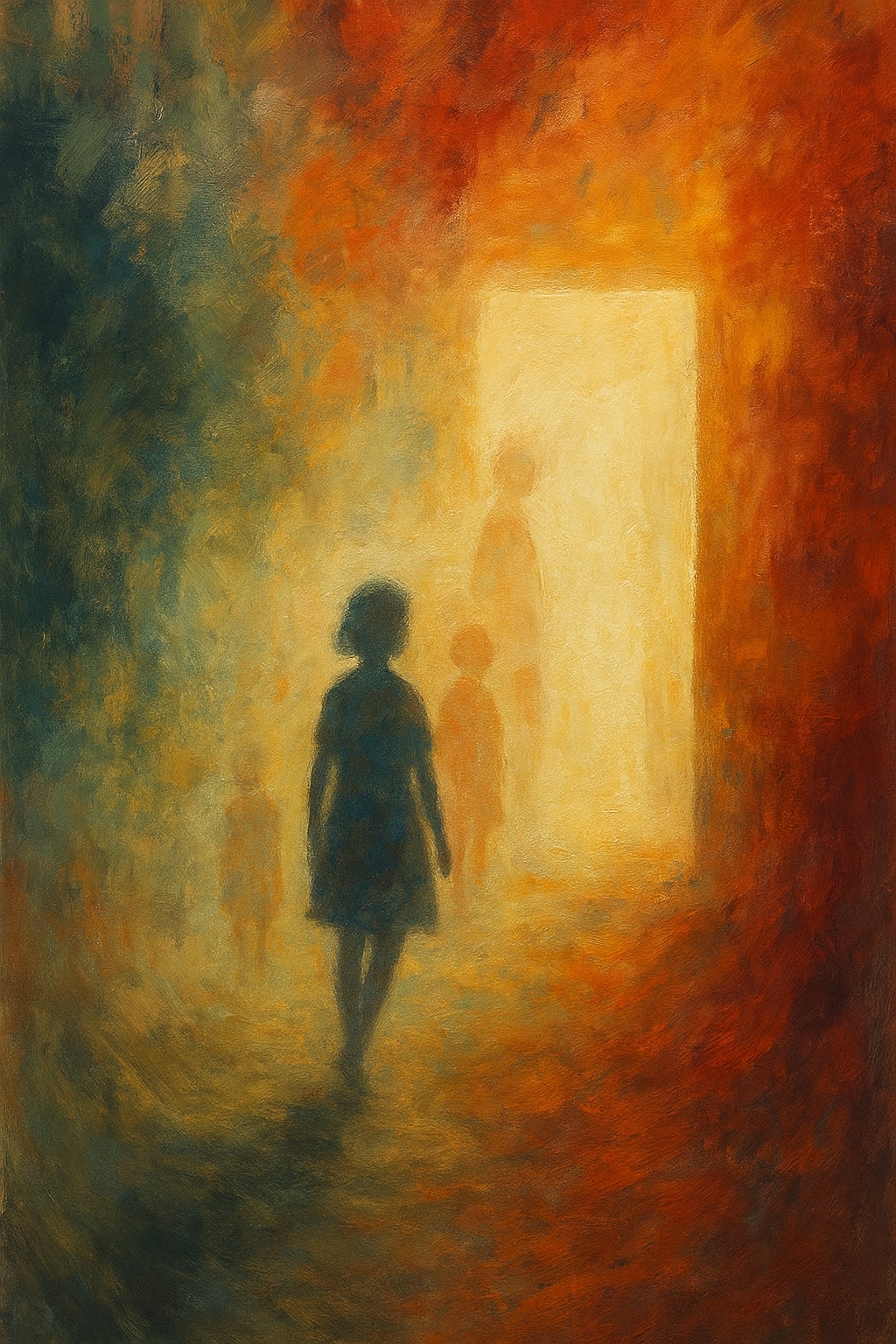
The fluorescent lights hum their familiar tune above me, a soft electrical lullaby that never changes pitch or rhythm. I’ve heard this sound for so long now that silence would feel like deafness. The examination paper crackles as I smooth it across the table, each wrinkle a small protest against order.
Then I hear them, small footsteps in the hallway outside. Quick, light steps that barely disturb the air. A child’s feet, moving with that particular mixture of curiosity and hesitation that comes before entering unknown spaces.
The door opens without ceremony. She cannot be more than five, with dark hair that catches the overhead light in uneven waves. Her mother must have brushed it this morning, but it has already begun its rebellion. She wears a yellow dress with tiny flowers, and her shoes light up when she walks, small bursts of blue and red with each step.
“Hello,” I say, my voice finding its familiar cadence. “You can sit right here.”
She climbs onto the chair beside my desk, her legs swinging freely, nowhere near the floor. From my drawer, I retrieve the box of crayons and a fresh sheet of paper. Her eyes widen with the particular delight that children reserve for unexpected gifts.
While I prepare my instruments, she begins to draw. Her small fingers grip the red crayon with fierce concentration, creating shapes that might be flowers or perhaps small suns. I arrange the stethoscope around my neck, feeling its cool weight settle into place.
“What are you drawing?” I ask.
“My house,” she says without looking up. “And the tree in our yard. It has a swing.”
I watch her work, noting the deliberate strokes, the way she chooses each color with careful consideration. Purple for the tree trunk. Green for something that could be grass or sky. Orange for what might be a cat, curled beneath her carefully constructed tree.
“That’s a beautiful house,” I tell her.
“My daddy built the swing,” she says, now reaching for the yellow crayon. “It goes really high. Sometimes I pretend I’m flying.”
I begin the examination routine, checking her ears, her throat, listening to the steady rhythm of her young heart through the stethoscope. She submits to this with patience, still clutching the purple crayon in her free hand.
“Can that thing hear dreams?” she asks suddenly, pointing at the stethoscope.
I pause, considering her question with the seriousness it deserves. “What do your dreams sound like?”
“Like music,” she says. “But not the kind from the radio. Different music. Like when the wind moves through our tree.”
I nod as if this makes perfect sense, because perhaps it does. “Then maybe it can.”
She seems satisfied with this answer and returns to her drawing, adding what appears to be a second story to her house. I complete the routine measurements, noting everything in my file as I always do. Height, weight, reflexes, responses. The mundane mathematics of a healthy child.
When we finish, she hops down from the chair and hands me her drawing. “This is for you,” she says.
I accept it with both hands, studying her creation more carefully now. The house sits beneath a generous sky, the tree with its swing reaching toward the upper corner of the page. The orange cat sleeps peacefully in crayon grass. In the bottom right corner, she has drawn what might be a person, a simple figure with a circle head and stick arms, standing beside the house.
“Is this you?” I ask, pointing to the figure.
“That’s you,” she says matter-of-factly. “You live there too now.”
Before I can respond, her mother appears in the doorway, keys jingling in her hand. “All finished? Come on, sweetheart, we have to go.”
The child waves goodbye with the same casual warmth she brought into the room, her light-up shoes flashing as she follows her mother into the hallway. The door closes behind them with a soft click.
I remain standing in the center of the room, holding her drawing. The fluorescent lights continue their steady hum. The examination paper crackles as it settles. Everything returns to its proper order, except for this piece of paper in my hands, this small disruption in the pattern.
I look at the figure she drew beside her house, simple lines that somehow managed to capture something essential. Me, according to her. Living in a world of swings and orange cats and trees that sing like wind.
I place the drawing on my desk and begin preparing the room for the next appointment. Fresh paper on the table. Clean instruments arranged in their proper positions. Everything as it should be.
But I find myself glancing back at the drawing, at the small person she placed so carefully beside her crayon house. As if I belonged there. As if I had always belonged there.
The fluorescent hum fills the space between heartbeats. I place her drawing in a frame on the wall, the house with its generous tree, the orange cat, the figure she insisted was me. It sits beside the certificates and diplomas, looking oddly at home among the formal documents.
The footsteps approaching are different now. Heavier. More deliberate, but with an edge of reluctance that drags against the polished floor. When the door opens, I recognize her immediately, though seven years have carved new angles into her face.
She’s twelve now, all elbows and knees and carefully constructed defiance. Her hair hangs across one eye, a curtain she can hide behind when the world demands too much. She wears jeans with deliberate holes and a t-shirt that proclaims her allegiance to some band I don’t recognize.
“Do I have to be here?” she asks, not quite meeting my eyes.
“Just a routine check-up,” I say, gesturing toward the examination table. “It won’t take long.”
She rolls her eyes with practiced precision, but complies, climbing onto the table with the studied boredom of someone who has learned that adults rarely change their minds about these things. I retrieve the same instruments, follow the same patterns, but everything feels different now. She has developed opinions about everything.
“This is stupid,” she mutters as I check her reflexes. “I feel fine. My mom’s just paranoid.”
I nod and continue my work. Her heartbeat has changed, stronger now, more complex. The simple rhythm of childhood has given way to something with more variations, like a song learning new verses.
“How’s school?” I ask.
“Terrible. Everyone’s fake. The teachers don’t care, and the other kids are…” She trails off, shrugging in that universal gesture of adolescent frustration. “Whatever.”
While I update my notes, she fidgets on the examination table, her legs swinging with less joy than they once did. Her gaze wanders around the room, taking inventory of everything she doesn’t remember examining before.
Then she stops. Her eyes have found the framed drawing on the wall.
“That’s weird,” she says, tilting her head to study it more closely. “I used to draw like that.”
Something cold moves through me, something that tastes like metal. “Did you?”
“Yeah, when I was little. I drew the exact same house. Same tree, same everything.” She squints at the drawing, as if trying to decode a message written in a language she’s forgotten. “That orange blob is supposed to be a cat. I always drew cats like that.”
I set down my pen and look at her, really look at her. The shape of her eyes, the particular way her hair falls across her forehead, the small scar on her chin that she got from falling off her bicycle when she was eight.
“Do you remember drawing this one?” I ask carefully.
She shakes her head, but her frown deepens. “No, but… I don’t know. It’s like déjà vu or something. This whole room feels familiar.” She looks around again, more slowly this time. “Have I been here before?”
“What do you think?”
“I think I’d remember,” she says, but uncertainty creeps into her voice. “Wouldn’t I?”
I finish the examination in relative silence, both of us caught in the strange gravity of a question that has no safe answer. She submits to the routine with less resistance now, as if the mystery of the drawing has temporarily quieted her rebellion.
When I tell her she’s healthy, she nods absently. Her attention keeps drifting back to the wall, to the small figure standing beside the crayon house.
“Who’s that supposed to be?” she asks, pointing at the stick figure.
“What do you think?”
She studies it for a long moment. “It looks lonely,” she says finally. “Standing there by itself.”
Before I can respond, her mother calls from the hallway. “Ready to go, honey?”
She hops down from the table, her earlier defiance returning like armor she puts on before facing the world. But at the door, she pauses and looks back at the drawing one more time.
“It’s good,” she says quietly. “Whoever drew it. They were good at making things look… happy.”
After she leaves, I stand in the center of the room, surrounded by the familiar hum of lights and the whisper of settling paper. I look at the drawing through her eyes, the careful strokes, the deliberate color choices, the small world where everything has its proper place.
She’s right. It does look happy. And the figure beside the house does look lonely.
I make my notes in her file, recording the routine measurements, the normal responses. But in the margin, I write something else. “Patient shows no conscious recall of previous visit, but demonstrates strong unconscious recognition patterns.”
I prepare the room for the next appointment. The room simply waits, holding its breath, until she needs to return.
The fluorescent lights continue their eternal conversation with themselves. I haven’t moved from this room, haven’t felt the need for food or rest or any of the usual requirements that mark the passage of hours. The drawing remains in its frame, the examination table holds its fresh paper, and my instruments wait in their sterile arrangement.
Then the footsteps return, confident now, with a rhythm that speaks of someone who knows exactly where she’s going and why. The door opens with more force than before, and she enters like she’s walking into her own story.
Eighteen suits her. She carries herself with the particular grace of someone who has just discovered she can be whoever she chooses to be. Her hair is shorter now, styled with intention, and she wears clothes that make statements about art and independence and the kind of person who reads books that matter. There’s a silver ring on her thumb and paint under her fingernails.
“Good morning,” she says, and her voice has found its adult register, warm, clear, unafraid.
“Good morning. How are you feeling?”
“Incredible, actually.” She settles onto the examination table with easy familiarity, as if she’s done this a thousand times. “I got into State. Full scholarship. I’m going to study literature and maybe psychology. Haven’t decided yet.”
I begin the routine, but everything about her presence has changed the room’s atmosphere. She talks while I work, filling the space with plans and dreams and theories about everything.
“I’ve been thinking about memory lately,” she says as I check her blood pressure. “Like, how do we know which memories are real? I mean, really real, not just what we think happened?”
“What do you think?”
“I think most of what we remember is just stories we tell ourselves to make sense of the chaos.” She gestures around the room with her free arm. “Like this place. It feels so familiar, but I know I’ve never been here before. Well, not as me. Not as who I am now.”
Something shifts in my chest, a flutter that shouldn’t exist. “What makes you say that?”
“Because I’d remember you,” she says simply. “You have kind eyes. I always remember people with kind eyes.”
I pause in my examination, meeting her gaze for a moment longer than protocol suggests. She smiles, and I see echoes of the five-year-old who drew houses and the twelve-year-old who questioned everything.
“Plus,” she continues, “this room never changes. Look around. Everything’s exactly the same as… well, as it should be. Like it’s waiting.”
“Waiting for what?”
“For me to figure out why I keep coming back.”
The words drift between us like stones dropped into shallow water. I continue with the examination, checking her reflexes, listening to her heart, which beats with a steady strength that speaks of someone ready to take on the world.
“Are you nervous about college?” I ask.
“Terrified,” she admits cheerfully. “But the good kind of terrified. Like standing at the edge of a cliff, knowing you’re about to fly.” She pauses, considering something. “I met someone. His name is David. He makes me laugh at things that aren’t even funny.”
“That sounds important.”
“It is. I think. I don’t know much about love yet, but I know it feels like coming home to somewhere you’ve never been.”
I make my notes, recording the standard measurements, but her words echo between numbers. She talks about her future like it’s a country she’s about to visit, full of unknown territories and adventures waiting to be discovered.
“Can I ask you something?” she says as I finish.
“Of course.”
“Do you ever get lonely? Working in here all by yourself?”
The question catches me off guard. Not because it’s unexpected, but because it requires an answer I’m not sure I’m allowed to give.
“Sometimes,” I say carefully.
“I thought so.” She looks at the drawing on the wall again, and something flickers across her face, recognition, maybe, or just the shadow of it. “That’s beautiful, by the way. Whoever drew that understood something about happiness.”
“What do you think they understood?”
“That it’s not about the house or the tree or even the cat. It’s about the person standing beside it all. Having someone to witness your little world.” She tilts her head, studying the stick figure more closely. “Though they look a little sad, don’t they?”
Before I can respond, she hops down from the table with the easy grace of someone who owns her body completely. “Well, I should go. David’s picking me up. We’re driving to the coast today, just because we can.”
She moves toward the door, then stops and turns back. “Thank you. For listening, I mean. Most adults don’t really hear what you’re saying. They just wait for you to stop talking.”
“Take care of yourself,” I tell her.
“I will. And maybe I’ll see you again sometime. Though I probably won’t remember, will I?”
The question evaporates in the air like smoke. She doesn’t wait for an answer, just smiles and disappears into the hallway, leaving behind the faint scent of art supplies and possibility.
I remain standing in the center of the room, listening to the familiar hum of lights that never dim, surrounded by air that still holds the electric charge of her presence. For the first time in longer than I can measure, I notice the silence that follows her leaving.
In my notes, I write: “Patient demonstrates increased self-awareness and emotional intelligence. Strong unconscious familiarity with environment. Questions suggest developing intuitive understanding of temporal anomaly.”
Then, in smaller writing, I add: “She asked if I get lonely.”
The room settles back into its waiting stillness, but something has shifted. The air feels different. Charged. As if her questions have awakened possibilities that were better left sleeping.
She arrives twenty minutes late. Her footsteps in the hallway lack the confident rhythm of her previous visit, they drag slightly, as if each step requires negotiation with gravity.
When she enters, I see the exhaustion first. It sits beneath her eyes in dark crescents, maps the tension in her shoulders. Twenty-five has carved new lines around her mouth, not from laughter this time.
“Sorry I’m late,” she says, not meeting my eyes. “Traffic was insane.”
There was no traffic. There never is, in this place between moments. But I don’t correct her.
She wears a long-sleeved shirt despite the warmth, and when she pushes up the fabric to rest her arm on the table, I see the purple bloom on her forearm. Fresh. Maybe two days old.
“How have you been?” I ask.
“Fine.” The word comes too quickly, too sharp. “Just tired. Work’s been crazy.”
I begin the examination, but her body tells a different story than her words. She flinches when I check her lymph nodes. Her pulse runs faster than it should. When I ask her to look up so I can examine her throat, she tilts her head in a way that keeps her neck covered.
“Any changes in your sleep patterns?”
“I don’t sleep much anymore.” She stares at the ceiling tiles. “When I do, I have weird dreams. About rooms like this one. About conversations I never had.”
The stethoscope reveals her heart working harder than necessary, like an engine running on the wrong fuel. I make my notes, but each observation feels heavier than the last.
“Can I ask about the bruise?”
“What bruise?” But her free hand instinctively covers her forearm.
I don’t push. Instead, I continue the examination in careful silence, letting her control what she chooses to reveal. After a few minutes, she speaks again.
“I used to love this room.” Her voice is quieter now. “It felt safe. But now…” She looks around with something that might be disappointment. “Now it reminds me of things I don’t want to admit.”
“What kind of things?”
She laughs, but there’s no humor in it. “That I’m not who I thought I’d become. That the girl who was going to change the world can’t even change her own situation.”
She catches sight of herself in the reflection of the instrument tray and recoils slightly, as if the person looking back is a stranger she doesn’t particularly like.
“David and I broke up six months ago,” she says to the ceiling. “Turns out love isn’t enough when you don’t know how to be loved. Turns out I’m really good at choosing people who hurt me.”
The words are like glass breaking. I set down my clipboard and wait.
“I keep thinking about that drawing on your wall,” she continues. “The little girl who drew that believed in happy endings. She thought if you just stood next to something beautiful, you’d be beautiful too.”
Her voice cracks on the last word, and suddenly there are tears tracking down her cheeks. Not the dramatic crying of movies, just the quiet overflow of someone who has been holding too much for too long.
I reach into my desk drawer and place a box of tissues on the table beside her. Not a word, just the soft sound of cardboard against metal.
She takes one, then another, dabbing at her eyes with movements that suggest she’s had practice at crying silently.
“I’m sorry,” she whispers. “I don’t know why I’m telling you this. You’re just trying to do your job.”
“It’s okay.”
“Is it, though?” She looks at me directly for the first time since entering. “Because I feel like I’ve been here before. Like we’ve had this exact conversation. And if we have, then you already know how this story ends.”
The statement haunts the room, filled with answers I’m not prepared to address. Her eyes search my face for clues I don’t know how to give.
“Do you think,” she asks quietly, “that some people are just meant to be broken?”
“No,” I say, and the certainty in my voice surprises us both.
I watch her dab at her eyes. Without speaking, I move to the wall and carefully remove the framed drawing, her five-year-old self’s vision of happiness preserved behind glass, and place it gently on the examination table beside her.
“You made this,” I say quietly. “A long time ago.”
She stares at the colors, the careful strokes, the small world where everything had its proper place. Her fingers trace the edges of the paper through the glass.
“I remember,” she whispers. “I was so sure about everything then.”
I remove the drawing from its frame and place it directly in her hands.
She holds it like something precious and fragile, and for the first time since entering the room, her tears feel different.
“Can I… can I keep this?”
“It was always yours.”
She nods slowly, as if filing this response away for later consideration. When she slides down from the examination table, her movements are careful, deliberate. Someone who has learned not to trust her own body.
“Thank you,” she says at the door. “For the tissues. For not asking too many questions.”
After she leaves, I remain standing in the center of the room, surrounded by the familiar hum that suddenly feels less comforting than it once did. The tissue box sits where I placed it, two tissues missing from the perfectly ordered stack.
In my notes, I write: “Patient shows signs of psychological distress. Physical indicators suggest possible domestic situation. Unconscious familiarity patterns remain consistent.”
Then I pause, pen hovering over paper, and add: “She asked if some people are meant to be broken. I told her no. I hope I was right.”
Almost as soon as the room is prepared, her footsteps approach again, with a different quality. Measured, unhurried, like someone who has learned to carry time rather than be carried by it. When she enters, thirty-five wears her well. The sharp edges of her twenties have softened into something more substantial, more rooted.
She moves with the particular grace of mothers, economical gestures, hands that know exactly where everything belongs. Her hair is longer again, streaked with silver she hasn’t bothered to hide, and there are laugh lines around her eyes that weren’t there before.
“Hello,” she says, settling onto the examination table with familiar ease. “Sorry if I smell like finger paint. Tommy had an art project this morning.”
Tommy. A name that carries weight, history, the sound of small feet running through rooms I’ll never see.
“How old is Tommy?” I ask, beginning the routine.
“Six. And Sarah just turned three.” Her face transforms when she talks about them, becoming luminous in a way that has nothing to do with the fluorescent lights. “They’re at my mother’s today. Probably destroying her kitchen as we speak.”
I check her pulse, noting how steady it runs now. No racing, no irregularities. Just the strong, reliable rhythm of someone who has found her center.
“This is my favorite hour of the month,” she says, looking around the room with something that might be affection. “The only place where no one asks me for anything. Where I don’t have to be anyone’s mother or employee or daughter or neighbor. I can just… exist.”
She pauses, studying the wall where the drawing once hung in its simple frame. “I owe you an apology.”
“For what?”
“For how I was before. In my twenties. All that anger and sadness I brought in here.” She shakes her head. “You didn’t deserve that. You were just trying to help.”
I continue the examination in careful silence, but something shifts in the space between us. A door opening that I hadn’t realized was closed.
“I understand now why I kept coming back to this room, even when I didn’t remember being here before.” She watches me work with curious eyes. “It’s because you see me. Not the version of me that everyone else needs, just… me.”
Her heart sounds different through the stethoscope, fuller somehow, like a bell that has learned to ring true. I make my notes, recording the physical markers of a woman who has made peace with herself.
“The funny thing about having children,” she continues, “is that you spend so much time taking care of everyone else that you forget you exist as a separate person. But here…” She gestures around the room. “Here I remember.”
“What do you remember?”
“That I was five once, and drew pictures of houses with swings. That I was eighteen and thought I could save the world. That I was twenty-five and thought the world was trying to kill me.” She smiles. “All true. All me.”
When I finish the examination, she doesn’t immediately move to leave. Instead, she sits quietly, running her fingers through her hair in an absent gesture. One strand comes loose, silver and brown woven together, and drifts to the floor beside the examination table.
“Thank you,” she says finally. “For being constant. For being here whenever I need to remember who I am underneath everything else.”
She slides down from the table and moves toward the door, then pauses. “I know this sounds strange, but I feel like I’ve been having this conversation with you my whole life. Like you’re the one person who knows all my versions.”
After she leaves, I remain standing in the center of the room, but now the silence feels different. Not empty, but full.
I bend and pick up the strand of hair she left behind, silver and brown catching the light like spun metal. For a long moment, I hold it between my fingers, studying the way it curves, the particular texture that speaks of someone who has lived fully.
In my notes, I write: “Patient demonstrates significant emotional growth and self-awareness. Physical health optimal. Reports positive family relationships and strong sense of identity.”
Then I pause, looking at the strand of hair still resting in my palm. In the margin, I add: “She said I see her. I think she sees me too.”
I place the hair carefully between the pages of her file, where it will remain long after everything else fades. A small proof that this moment existed, that she was here, that we understood each other in ways that transcend the ordinary boundaries of doctor and patient.
The room settles back into its waiting stillness, but the quality of the silence has changed. It no longer feels like absence. It feels like presence, her presence, lingering in the spaces between my thoughts.
She moves differently when she next arrives. Not dramatically, fifty hasn’t stolen her grace, but there’s a new deliberateness to each step, as if her body has begun negotiating with time. Her hair has surrendered completely to silver, worn in a shorter style that frames a face marked by decades of laughter and worry in equal measure.
“The kids are in college now,” she says, settling onto the examination table with careful attention. “Sarah’s studying marine biology. Tommy’s doing something with computers that I pretend to understand.”
I begin the routine, but my hands feel heavier. The stethoscope seems to carry more weight as I place it against her chest, listening to the familiar rhythm that has marked our time together.
Then I hear it. A skip. A hesitation in the steady beat I’ve known for so long.
My hand trembles, just slightly, but enough that she notices.
“What is it?” she asks.
“Probably nothing. An irregular heartbeat is common at your age.” But the words taste like lies, and she knows it.
I continue the examination, checking her lymph nodes, her blood pressure, the small territories of her body that have become familiar landscapes. Everything else appears normal, but that hesitation in her heart echoes in my chest like a warning bell.
“I’ve been having the strangest dreams,” she says as I make my notes. “The same one, over and over. I’m standing outside this room, reaching for the door handle, but when it opens…” She pauses, looking past me at something I can’t see. “There’s nothing there. Just empty space. Void.”
My pen stops moving across the paper. In all our years of routine, I’ve never forgotten to ask a question. But now, faced with the hidden subtext of her words, I find myself silent.
“Does that mean something?” she asks. “Dreaming about nothingness?”
I should ask about her family history. I should inquire about stress levels, exercise habits, dietary changes. These are the questions that belong in this moment, the professional responses that maintain the careful distance between us.
Instead, I ask, “Are you afraid?”
She considers this with the same thoughtfulness she’s brought to every conversation we’ve shared. “Not of dying, exactly. But of… disappearing. Of becoming nothing before I’m done being something.”
She looks around the room with eyes that see more than they once did. “This is going to sound crazy, but I think this place is more real than the rest of it. My house, my job, even my children, sometimes they feel like shadows compared to this room. Like they’re the dream, and this is where I actually exist.”
The fluorescent lights continue their eternal hum, but something in their frequency has changed. Or perhaps it’s my hearing that has shifted, tuned now to registers I couldn’t detect before.
“How long have we been doing this?” she asks suddenly, and I realize I’ve been holding my breath.
“A while,” I say finally.
“It feels like forever. Like we’ve always been here, in this room, having this conversation.” She tilts her head, studying my face with new intensity. “Do you age? I’ve never thought to ask before.”
Before I can answer, she continues. “Because I look different every time I see myself in that mirror, but you… you’re exactly the same. Always exactly the same.”
I make a note about the irregular heartbeat, about the need for follow-up testing, but my handwriting looks unfamiliar to me. Shakier than it should be.
“Will I see you again?” she asks as she prepares to leave.
It’s the first time she’s ever asked this question, and it breaks my heart. Because for the first time, I’m not certain of the answer.
“I hope so,” I tell her.
She nods, accepting this uncertainty with the grace she’s cultivated over our decades together. At the door, she pauses and looks back at the drawing on the wall, her five-year-old self’s vision of happiness.
“I used to think that little girl was naive,” she says. “Drawing a world where everyone belongs somewhere. But maybe she understood something I’m just learning.”
“What’s that?”
“That the most real things aren’t always the most permanent ones.”
After she leaves, I remain standing in the center of the room, listening to the familiar hum that suddenly sounds different. Temporary. As if the lights themselves have become aware of their own mortality.
In my notes, I write: “Patient presents with cardiac irregularity requiring further evaluation. Reports recurring dreams about void/emptiness. Demonstrates increased philosophical awareness of temporal nature of existence.”
Then, in the margin, I add something I’ve never written before: “I’m afraid too.”
As soon as the room is ready, she returns. Entering slowly, her hand gripping the doorframe for support. Seventy has carved deep channels in her face, and her hair has gone completely white, fine as spider silk. But it’s her eyes that tell the true story, they search the room like someone trying to solve a puzzle with half the pieces missing.
“Where am I?” she asks, the question triggering my concern.
“You’re in the examination room,” I say gently. “For your appointment.”
She nods, but I can see the words slip through her mind like water through a sieve. She looks around with the careful attention of someone trying to memorize a foreign landscape.
“I know this place,” she murmurs, then shakes her head. “No, that’s not right. I don’t know anything anymore.”
I help her onto the examination table, noting how frail she’s become. Her bones feel hollow beneath my hands, like a bird’s skeleton. When I reach for the stethoscope, she flinches.
“It’s all right,” I tell her. “I’m just going to listen to your heart.”
“My heart’s broken,” she says matter-of-factly. “Has been for years. Ever since Robert died.”
Robert. A name I’ve never heard her speak before, but I understand immediately. Her husband. The father of Tommy and Sarah, who must be grown now, with children of their own.
“Tell me about Robert,” I say, continuing the examination.
“He’s in the garden,” she says, looking past me toward the wall. “He’s planting those roses I like. The yellow ones. He says yellow roses mean friendship, but I think they mean hope.”
I follow her gaze to the empty wall, seeing nothing but medical certificates. But I nod anyway.
“He sounds like a good man.”
“The best. We were married forty-three years. He still brings me coffee in bed every morning.” She pauses, confusion flickering across her features. “Or did he? I can’t remember if that was yesterday or forty years ago.”
As I check her reflexes, she continues talking to the empty space beside the examination table.
“Robert, this is the doctor I told you about. The one who listens.” She turns to me with sudden clarity. “He’s shy around new people, but he’ll warm up to you.”
I set down my reflex hammer and look at her directly. “I’m honored to meet him.”
Her face brightens with genuine joy. “He likes you already. I can tell.”
But then the light fades from her eyes, replaced by something that might be panic. She looks around the room again, no longer seeing familiar spaces but strange territories.
“I don’t remember how to leave,” she whispers. “I know I came in through that door, but I don’t remember the way back.”
I move to her side, placing a gentle hand on her shoulder. “I’ll help you. When you’re ready.”
“Are you David?” she asks suddenly, squinting at my face. “You look like David. He was going to take me to the coast.”
“I’m your doctor,” I say softly.
“Oh.” She seems to fold in on herself slightly. “I thought you were someone else. Someone I used to know.”
The silence stretches between us, filled only by the hum of fluorescent lights and the whisper of her breathing. Then she looks up at me with eyes that, for a moment, seem to clear.
“Have I been here before?”
The question sounds like a prayer waiting for an answer. I lean closer, close enough that she can see my face clearly, close enough that my words won’t get lost in the spaces between her thoughts.
“Every time,” I whisper.
She nods slowly, as if this makes perfect sense, as if she’s been waiting her whole life for someone to tell her this truth.
“Every time,” she repeats, tasting the words. “That’s good. That’s very good.”
When I help her to the door, she moves like someone walking through water. At the threshold, she turns back to the empty room.
“Goodbye, Robert,” she says to the space where she imagined him standing. “I’ll see you at dinner.”
Then she looks at me with sudden urgency. “Will you tell him I was here? In case he forgets?”
“I will.”
After she leaves, I remain standing in the doorway, looking back at the examination table where she spoke to ghosts and called me by names I’ve never owned. The room feels different now, not just waiting, but haunted by the presence of everyone she can no longer remember.
In my notes, I write: “Patient shows significant cognitive decline. Experiences temporal displacement and hallucinatory episodes. Still demonstrates emotional connection to familiar environments despite memory loss.”
But beneath that, in handwriting that trembles more than it should, I add: “She’s forgetting everything except this room. She’s forgetting everyone except me. And I don’t know if that’s a gift or a curse.”
Before long, she arrives in a wheelchair, pushed by no one I can see. Eighty-five has made her small, translucent, like tissue paper held up to light. But her eyes, her eyes are clear as mountain streams, sharp with the particular clarity that sometimes comes at the very end of things.
“Hello, old friend,” she says, her voice carrying the depth of decades.
I help her from the wheelchair to the examination table, noting how little she weighs now, how her bones feel like hollow reeds beneath skin that seems barely tethered to this world. But when she looks at me, I see all of her gathered there, the five-year-old with her crayons, the eighteen-year-old with her dreams, the twenty-five-year-old with her bruises, the thirty-five-year-old with her children, the fifty-year-old with her fears.
“I’ve figured it out,” she says simply. “This place. What it is.”
I pause in arranging my instruments, waiting.
“It’s not for the body, is it? All these examinations, all these measurements. They were never about my heart or my reflexes or whether I was growing properly.” She gestures around the room with hands that shake only slightly. “This place is for the soul. You’ve been examining my soul.”
The words shift the very frequency of the room’s eternal hum, as if the lights themselves have been waiting decades to hear this truth spoken.
“And you,” she continues, studying my face with eyes that see everything now. “You’re not really a doctor, are you? Not the kind that heals bodies.”
I set down my stethoscope and look at her directly. “What do you think I am?”
“A witness. A keeper of stories. Someone who watches over the parts of us that matter most.” She smiles, and the expression transforms her lined face into something luminous. “Someone who remembers when we forget.”
She reaches into a pocket I hadn’t noticed before and withdraws something carefully folded. When she opens it, I recognize the drawing immediately, her five-year-old self’s vision of home, the house with its generous tree, the orange cat, the stick figure standing beside it all.
“I kept this,” she says, smoothing the wrinkled paper with trembling fingers. “All these years, through every move, every loss, every change. I never knew why. But I kept it.”
She holds it out to me, and I see that the colors have faded, the edges worn soft from decades of handling. But the essential elements remain, the house, the tree, the figure she insisted was me.
“It belongs here,” she says. “It was always meant to be here.”
I accept the drawing with both hands, feeling its weight, heavier than paper should be, carrying the gravity of a lifetime’s worth of meaning.
“Thank you,” she whispers. “For seeing me through all of it. For being the one constant in a life full of variables. For watching over all my selves.”
I want to speak, to tell her what these visits have meant, how watching her grow and change and become herself has been the only real purpose I’ve known. But the words feel too small for what passes between us.
“I’m not afraid anymore,” she says, settling back against the examination table with a peace I’ve never seen in her before. “I understand now. This isn’t about ending. It’s about completion.”
She closes her eyes, and for a moment, she could be any age, five or fifteen or fifty. All of her gathered into this one perfect moment of understanding.
“Will it hurt?” she asks without opening her eyes.
“No,” I tell her, and I know this is true in ways that transcend medical knowledge.
She nods, satisfied. “Good. I’ve had enough of hurting.”
When she opens her eyes again, they shine with something that might be joy. “You know what the strangest part is? I remember everything now. Every visit, every conversation, every version of myself that walked through that door. They’re all here, all together, like voices in a choir.”
I help her back into the wheelchair, noting how she seems even lighter now, as if part of her has already begun the journey to wherever souls go when their examinations are complete.
At the door, she reaches out and takes my hand. Her skin is cool, soft as worn silk.
“Until next time,” she says.
But we both know there won’t be a next time. Not for her. Not in this room where time moves sideways and souls come to be measured and witnessed and remembered.
After she leaves, I remain standing in the center of the room, holding her childhood drawing. The fluorescent lights continue their eternal conversation, but their hum sounds different now. Final. Like a song reaching its last note.
I open her file and place the drawing carefully inside, next to the strand of silver-brown hair from years ago, next to all the measurements and observations that chart the course of a life examined with love.
In my notes, I write: “Patient demonstrates complete integration of life experience and acceptance of transition. Final examination complete. Soul assessed as whole, beautiful, and ready.”
Then I close the file and hesitate to place it in the drawer where it will rest until the room needs it again. And in between, the room waits in perfect silence.
No footsteps approach. No door opens. No voice calls greeting across the threshold between one moment and the next. The hum of the fluorescent lights has dimmed to something barely audible, as if even they understand the weight of this absence.
The examination table sits empty, its fresh paper unmarked by the shape of a body. But resting on its surface, placed with ceremonial precision, lies her file. Thick with decades of observations, measurements, the careful documentation of a soul examined and witnessed and loved. Beside it, the faded drawing, her five-year-old self’s vision of happiness, returned home at last.
I stand in the center of the room, surrounded by air that no longer carries the electricity of her presence. The silence is different from the waiting silences that have punctuated our years together. This is not the pause between breaths. This is the space after the final exhale.
My hands move without conscious thought, opening her file one last time. The pages whisper as I turn them, each sheet a chapter in the story of a life observed from beginning to end. Here, the measurements of a growing child. There, the notes about adolescent defiance, young adult hope, middle-aged wisdom, the gradual fade of memory. And finally, my last entry, “Soul assessed as whole, beautiful, and ready.”
I close the file with careful reverence, but my hands linger on its worn cover. Somewhere between the first entry and the last, between the five-year-old who asked if stethoscopes could hear dreams and the eighty-five-year-old who understood that this place was never about bodies at all, something has shifted inside me.
For the first time in longer than I can measure, I place my hand against my chest, fingers searching for something I’m not sure I’m supposed to possess. A heartbeat. A rhythm that might match the ones I’ve listened to for so many years.
There. Faint but present. The steady percussion of something that might be life, or might be something more complex than life. Something that began as clinical detachment and grew, visit by visit, into something I have no name for.
I breathe, or perform the motion that serves as breathing in this place between moments, and taste the air that still holds the faintest trace of her presence. The scent of someone who lived fully, loved deeply, carried children and sorrows and joys and dreams through eight and a half decades of becoming herself.
The drawing catches the light as I lift it, colors faded but essence intact. The house with its generous tree. The orange cat sleeping in crayon grass. The stick figure she insisted was me, standing witness to her small, perfect world. I trace the lines with one finger, feeling the slight indentations where a five-year-old pressed too hard with her crayons, determined to make something beautiful permanent.
She was right. I do live there now. In that space beside her carefully constructed happiness, in the role of witness she assigned me before either of us understood what that would mean.
The room settles deeper into its stillness, but something has changed in the quality of the silence. It no longer feels like absence. It feels like presence, her presence, not gone but absorbed into something that exists in the spaces between my thoughts, in the rhythm beneath my ribs, in the weight of a life fully witnessed and completely known.
I place the drawing back in her file, close it one final time, and carry it to the filing cabinet that has always stood in the corner, patient and eternal as everything else in this place. The drawer slides open without sound, revealing rows of other files, other lives, other souls examined and documented and remembered.
Her file takes its place among them, but something tells me it will not rest there long. Stories like hers have a way of returning, of insisting on being told again in different voices, with different faces, but always with the same essential truth at their center.
The lights dim further, or perhaps my perception has shifted. The room prepares itself for what comes next, arranging its silence into something expectant rather than final.
I return to my position at the center of the room, surrounded by the familiar hum that has become the soundtrack of my existence. But now I hear something new beneath it, a harmony I never noticed before, a counterpoint that might be the echo of every voice that has ever spoken in this space, every story that has ever been told within these walls.
And beneath it all, steady and sure, the sound of my own heartbeat, keeping time with rhythms I have listened to but never truly heard until now.
The examination table sits empty, its paper smooth and waiting.
But not for long.